

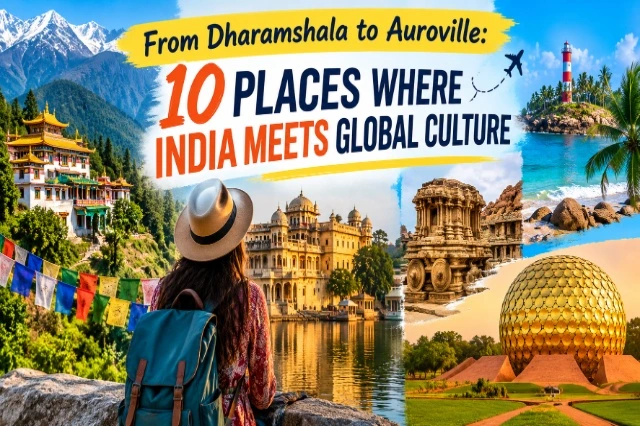
India is often introduced through the Taj Mahal, Jaipur’s forts, Kerala’s backwaters, and the busy streets of Delhi. These places are worth visiting, but there is another side of India that many international travellers discover only after spending more time here. Across the country, there are towns and villages where Indian traditions have naturally mixed with people and cultures from around the world. You may find a small café filled with backpackers, a yoga centre welcoming visitors from different countries, a Tibetan monastery, or a mountain village where travellers stay for weeks instead of days.
These places offer something different. They allow visitors to slow down, meet people, and experience everyday India while still finding familiar international travel spaces. Here are ten destinations where India meets the world.
1. McLeod Ganj and Dharamshala, Himachal Pradesh
McLeod Ganj is one of the clearest examples of this cultural mix. Located in the hills above Dharamshala, the town has a strong Tibetan influence and attracts travellers from across the world. The streets are filled with cafés, small shops, monasteries and guesthouses. You can spend the morning visiting the Tsuglagkhang Complex, stop for Tibetan food in the afternoon, and end the day looking out over the mountains.
For foreign visitors, McLeod Ganj can also be an easy introduction to travelling in the Himalayan region. The atmosphere is relaxed, and there is a large community of travellers who come for yoga, meditation, trekking, Tibetan culture or simply a few quiet days in the mountains. The journey from Delhi is long, but that is part of the experience. Travelling by private car gives visitors the freedom to stop along the way and break the journey according to their own pace.
2. Rishikesh, Uttarakhand
Rishikesh has become well known around the world for yoga and spirituality. International visitors arrive here for teacher-training courses, meditation retreats, river rafting and time away from busy city life. Walk around areas such as Tapovan and you will notice the mix almost immediately. Indian temples and ashrams stand alongside cafés, yoga studios and guesthouses catering to travellers from different countries.
The Ganges adds another dimension to the experience. One moment you may be watching an evening Ganga aarti, and the next you could be sitting in a café talking to travellers from another part of the world.
3. Pushkar, Rajasthan
Pushkar has a completely different setting, but it has developed its own international traveller culture. The small town surrounds the sacred Pushkar Lake and is known for its temples, colourful markets and annual camel fair. At the same time, its narrow streets are home to cafés and guesthouses that attract backpackers and long-stay travellers.
Pushkar is particularly interesting because the traditional and international sides of the town exist almost next to each other. You can visit a temple in the morning, browse a local market and later sit in a rooftop café watching the town become quieter as the sun goes down.
4. Kasol, Himachal Pradesh
Deep in the Parvati Valley, Kasol has become a familiar name among international backpackers and young travellers. The surrounding mountains are the biggest attraction, but the village itself has developed a distinctive traveller culture. Small cafés, guesthouses, trekking routes and nearby villages make it easy to spend several days here.
The road journey is an important part of reaching Kasol. The landscape changes gradually as you leave the plains behind and enter the Himalayan valleys. For travellers who prefer mountains and slower journeys over crowded sightseeing, Kasol can be an interesting addition to a Himachal road trip.
5. Old Manali, Himachal Pradesh
Manali is one of Himachal Pradesh’s most popular destinations, but Old Manali has a noticeably different atmosphere. Its narrow lanes are lined with cafés, guesthouses, small shops and places offering yoga or wellness activities. International travellers often stay here for longer periods, especially during the warmer months.
At the same time, traditional Himachali homes, apple orchards and mountain landscapes remain part of the surroundings. A private road journey from Delhi to Manali also allows travellers to see how dramatically the landscape changes during the trip, from the plains of northern India to the mountains of Himachal Pradesh.
6. Auroville, Tamil Nadu
Auroville is perhaps one of the most unusual destinations on this list. Located near Puducherry, Auroville was founded with the idea of creating an international community where people from different countries could live and work together. Visitors will find a mixture of sustainable projects, workshops, cafés, gardens and community spaces. The Matrimandir, with its distinctive golden exterior, is one of the best-known landmarks in the area.
Auroville is not a typical sightseeing destination. People often come because they are interested in sustainability, community living, meditation, alternative education or simply experiencing a different way of life.
7. Varkala, Kerala
Varkala combines Kerala’s coastal landscape with a relaxed international traveller scene. The famous cliff overlooking the Arabian Sea is lined with cafés, restaurants, small shops and places offering yoga and Ayurveda experiences. Travellers can easily spend several days here without following a strict sightseeing schedule.
The surrounding region provides another side of Kerala. Local villages, temples, backwaters and traditional food are all within reach. For someone visiting India for the first time, Varkala offers a comfortable balance between local culture and an international beach-town atmosphere.
8. Hampi, Karnataka
Hampi is known primarily for its remarkable ruins and history, but it has also become a favourite stop for travellers who prefer a slower style of travel. The remains of the Vijayanagara Empire spread across a landscape of huge boulders, temples and open fields. Around the area, travellers can find simple cafés, guesthouses and local businesses serving visitors from different parts of the world.
What makes Hampi special is the combination of history and everyday village life. You are not simply walking through an archaeological site. You are moving through a living landscape where local communities continue their daily routines around the ancient ruins.
9. Leh, Ladakh
Leh attracts a different kind of international traveller people looking for mountains, adventure and high-altitude landscapes. The town is surrounded by monasteries, mountain passes and some of the most dramatic scenery in northern India. Travellers come for motorcycle journeys, trekking, photography, monasteries and road trips through Ladakh.
The journey to Leh can itself become one of the highlights. The changing landscapes, remote settlements and mountain roads give visitors a glimpse of a side of India that feels very different from the major cities. Because of the altitude and long distances involved, travellers should plan their journey carefully and allow time to acclimatise.
10. Goa Beyond the Main Beaches
Goa is already popular with international tourists, but there is more to the state than its busiest beaches. Places such as Arambol have developed a strong backpacker and international traveller culture. Yoga sessions, music, cafés, local markets and beachside gatherings create a relaxed atmosphere.
Away from the coast, however, another Goa begins to appear. Portuguese-influenced architecture, small villages, churches, rice fields and local food offer opportunities to experience the state’s history and culture. Hiring a car can make it easier to move between the beaches and the quieter inland areas without being restricted to one part of Goa.
Why These Places Are Different
What connects these destinations is not a single attraction. It is the atmosphere. They are places where travellers can stay a little longer, meet people from different countries and still experience the local culture around them. You can have Tibetan food in the Himalayas, practise yoga beside the Ganges, explore a Rajasthani market in the morning, or sit beside the sea in Kerala in the evening. For international visitors, this combination can make travelling through India feel less rushed and more personal.
Many of these destinations are best experienced as part of a road journey rather than a quick stop. Travelling by private car gives international visitors more flexibility. You can decide where to stop, take breaks when needed, carry your luggage comfortably and adjust your itinerary along the way. For travellers starting in Delhi, destinations such as Rishikesh, Dharamshala, Kasol, Manali and Rajasthan can be incorporated into different road-trip plans depending on the time available. India has plenty of famous destinations. But sometimes the most memorable part of the journey is the place you discover between them.
Travel With Us
India is a country best experienced at your own pace. If you are planning to explore beyond the usual tourist routes, having a comfortable car and an experienced driver can make the journey much easier. Whether you are travelling from Delhi to the mountains of Himachal Pradesh, exploring Rajasthan’s smaller towns, or planning a longer journey across India, Car Rental Delhi with Driver can help you travel comfortably and at your own pace.
We provide private car rental services with drivers for local sightseeing, airport transfers, outstation journeys and multi-day road trips. So, pack your bags, choose your route, and let the road become part of your Indian adventure. Travel with us. Discover more of India, one road at a time.